Tampilkan postingan dengan label histogram. Tampilkan semua postingan

Drawing Random Numbers with Playing Cards 


An Easy Way to Get Random Numbers

Need an easy and fun way to draw random is to use a playing deck of cards.  No electricity or potentially expensive electronic devices are needed, and your shuffling skills will improve dramatically.  
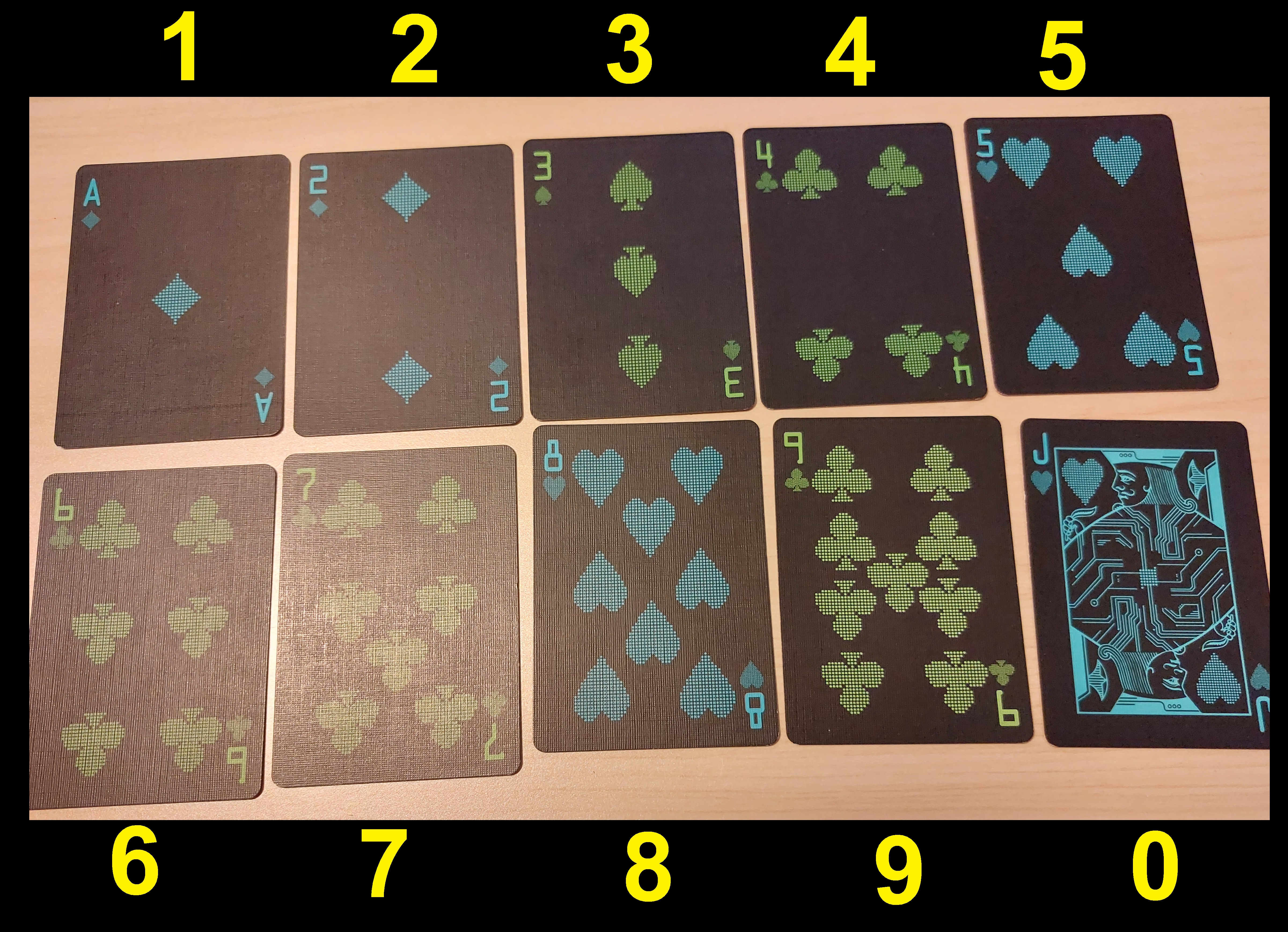


Take a regular deck of cards, and you will only need 40 cards.  Get all the Aces, ones through nines, and one set of face cards.   Assign the following cards as the following values:


Aces:  1

Twos:  2

Threes: 3

Fours: 4

Fives: 5

Sixes: 6

Sevens: 7

Eights: 8

Nines: 9

Any set of face card or tens: 0  (I use Jacks, see the pictures above.  You can use Queens, Kings, or Tens)


To get a random number:

1.  Shuffle the deck

2.  Draw up to four cards 

3.  That card becomes the random number.  Insert a decimal point anywhere if appropriate.  


Why only up to four cards?  There are only four digits available per deck.  We are generating a samples with no replacement.  


Sample four digit numbers:

8-clubs, Ace-hearts, 2-clubs, 5-diamonds:  8125

2-diamonds, Ace-clubs, 3-clubs, 5-spades:  2135

4-hearts, 8-spades, 3-diamonds, 9-spades: 4839

4-hearts, 3-diamonds, 9-slides, 8-clubs: 4398

Jacks-clubs, Ace-clubs, 2-diamonds, 2-spades: 0122


How many possible permutations are possible with this deck?

2 digits:  nPr(40, 2) = 1560

3 digits:  nPr(40, 3) = 59,280

4 digits:  nPr(40, 4) = 2,193,360


Can we create a program to generate random numbers using this method?  

Yes.   I am using the TI-84 Plus CE to for this program.   The TI-84 has a randIntNoRep function, which generates a list of random integers without replacement.   The nice part of the is we are working with base 10, so the use of a remainder function will give the results we want: 0 through 9.  


Syntax:


Random Sample of Integers Without Replacement:

randIntNoRep(low, high, size of the sample)


Remainder function, which can be used as the modulus function.

remainder(x, y):  returns the remainder of x ÷ y


The program RANDDECK will generate a list and draw a histogram.


TI-84 Plus CE Program:  RANDDECK


"2022-08-16 EWS"

ClrHome

Disp "MAKE A 4 DIGIT,","NUMBER FROM A DECK 0-9"

Input "NO OF TRIALS: ", N

For(I,1,N)

randIntNoRep(1,40,4)→L6

remainder(L6,10)→L6

sum(L6*{1000,100,10,1})→N

If I=1

Then

{N}→L5

Else

augment(L5,{N})→L5

End

End

Pause L5

ClrHome

Disp "PRESS [ENTER] TO"

Pause "DISPLAY HISTOGRAM"

Plot1(Histogram,L5,1,BLUE)

PlotsOn 1

ZoomStat


Here is an example.


Until next time,


Eddie


All original content copyright, © 2011-2022.  Edward Shore.   Unauthorized use and/or unauthorized distribution for commercial purposes without express and written permission from the author is strictly prohibited.  This blog entry may be distributed for noncommercial purposes, provided that full credit is given to the author. 


Casio fx-CG 50: Random Walk Histogram

Casio fx-CG 50:  Random Walk Histogram


Mosquitos an Inspiration, What? 


Inspiration:  

Ellenberg, Jordan.   Shape:  The Hidden Geometry of Information, Biology, Strategy, Democracy, and Everything Else  Penguin Books:  New York, NY. 2021


The beginning of Chapter 4, Sir Ronald Ross proposes the problem:  In a simple case, a mosquito can only travel in one of two directions, which is northeast or southwest.   The goal was to find the average distance a mosquito is from its home after a given life span.


The program TWALK would address a similar problem.  


N = number of trials


S = number of steps the mosquito (or whatever you want to imagine) walks in a single direction


Each trial calculates the final position.  The program draws a histogram of all the trails.   


TWALK gives two choices:


(-1, 1):  Each turn, the mosquito must move forward 1 step or backward 1 step


(-1, 0, 1):  Each turn, the mosquito must either move forward 1 step, move backward 1 step, or stay still for one turn. 


Drawing an Histogram Program in Casio Programming


Syntax:


S-Grph#  DrawOn, Hist, List x, 1, [ColorLinkOff], [Color] ColorLighter


# = Graph 1, 2, 3

List x = List 1 to List 26

Color Commands:  ColorLinkOff, 

Colors: One of 8 eight colors

ColorLighter: the fill of the color is lighter than the bar


The color commands are optional.  If you are using a Casio fx-9750GIII, leave of the color commands.


Casio fx-CG50 Program TWALK


Text:

'ProgramMode:RUN

"EWS 2022-08-04"

"RANDOM WALK 2.0"

"NO. TRIALS"?->N

N->Dim List 26

"NO. STEPS"?->S

Menu "STEPS","_(-)_1,1",2,"-1,0,1",3

Lbl 2:2->F:Goto 1

Lbl 3:3->F:Goto 1

Lbl 1

For 1->I To N

F=2=>Sum (2*RanInt#(0,1,S)-1)->List 26[I]

F=3=>Sum (RanInt#((-)1,1,S))->List 26[I]

Next

"POSITIONS LIST:"Disps

List 26Disps

(-)S->H Start

1->H pitch

S-Gph1 DrawOn,Hist,List 26,1,ColorLinkOff,Blue ColorLighter 

DrawStat


On the Screen:

"EWS 2022-08-04"

"RANDOM WALK 2.0"

"NO. TRIALS"?→N

N→Dim List 26

"NO. STEPS"?→S

Menu "STEPS","-1,1",2,"-1,0,1",3

Lbl 2:2→F:Goto 1

Lbl 3:3→F:Goto 1

Lbl 1

For 1->I To N

F=2⇒Sum (2×RanInt#(0,1,S)-1)→List 26[I]

F=3⇒Sum (RanInt#(-1,1,S))→List 26[I]

Next

"POSITIONS LIST:"◢

List 26◢

-S->H Start

1->H pitch

S-Gph1 DrawOn,Hist,List 26,1,ColorLinkOff,Blue ColorLighter 

DrawStat


Examples


N = 50, S = 5


(-1, 1):  Mosquito cannot rest


(-1, 0, 1): Mosquito can rest


Wishing you an excellent day,


Eddie 


All original content copyright, © 2011-2022.  Edward Shore.   Unauthorized use and/or unauthorized distribution for commercial purposes without express and written permission from the author is strictly prohibited.  This blog entry may be distributed for noncommercial purposes, provided that full credit is given to the author. 


HP 32S and HP 32SII Week: Maximum, Minimum , Histogram

HP 32S and HP 32SII Week:  Maximum, Minimum , Histogram 


Introduction


The program takes data and determines:


*  maximum of the data set (X)

*  minimum of the data set (Y)

*  bin width using Scott's normal rule (h, see formula below)

*  number of bins (k, rounding is not included)


Scott's normal rule:

h = 3.49 * sx / (n^(1/3))


Number of bins:

k = (max - min) / h

In practice, take the ceiling of k.


Instructions


1.  Enter the first data point.

2.  Press XEQ D  (execute label D)

3.  Enter the next data point, press R/S.  Repeat until the last data point.

4.  Press XEQ C 


HP 32S/32SII Program:  Maximum, Minimum, Bin Width, Number of Bins

Total Size (labels D, S, C): 61.5, plus 48 bytes for statistical data

(D: 6.0, S: 18.0, C:  37.5)


D01 LBL D  // data

D02 CLΣ

D03 STO X

D04 STO Y


S01 LBL S

S02 RCL X

S03 x<>y

S04 x>y?

S05 STO X

S06 RCL Y

S07 x<>y

S08 x<y?

S09 STO Y

S10 Σ+

S11 STOP

S12 GTO S


C01 LBL C

C02 RCL X

C03 STOP

C04 RCL Y

C05 STOP

C06 -

C07 49

C08 1

C09 %   // C07 - C09: build 0.49 in 4.5 bytes instead of 9.5 bytes

C10 3

C11 +

C12 Sx

C13 ×

C14 n

C15 3

C16 1/x

C17 y^x

C18 ÷

C19 STO H

C20 STOP

C21 RCL X

C22 RCL- Y

C23 RCL÷ H

C24 STO K

C25 STOP


Example


Data Set:

4.0

5.8

5.7

5.2

4.6

4.9

6.3

7.1

6.6

6.4


4 XEQ D

5.8 R/S

5.7 R/S

...

6.4 R/S

XEQ C


X:  max:  7.1

Y:  min:  4

h:  1.58387549541

k:  1.95722454763  (2 bins)


Source:


"Histogram"  Wikipedia.  Last Updated March 28, 2022. https://en.wikipedia.org/wiki/Histogram  Last Accessed March 31, 2022.  


Up next:  a review of the HP 45 - May 9, 2022


Eddie 


All original content copyright, © 2011-2022.  Edward Shore.   Unauthorized use and/or unauthorized distribution for commercial purposes without express and written permission from the author is strictly prohibited.  This blog entry may be distributed for noncommercial purposes, provided that full credit is given to the author. 


Backlink 9999 Traffic Super

Order Now...!!!!