Tampilkan postingan dengan label arithmetic. Tampilkan semua postingan

HP Prime: Reversing an Integer's Digits

HP Prime:  Reversing an Integer's Digits


(Inspired by the HHC 2022 programming contest)


What Should I Add To Reverse the Digits?


Let A, B, C, D, and E be individual digits (0-9) of an integer.   AB would represent a two digit integer with the value of 10 * A + B.  ABC would represent a three digit integer with the value of 100 * A + 10 * B + C.


Reversing a Two Digit Integer


AB + # = BA

10 * A + B + # = 10 * B + A

# = 9 * (B - A)


Example:  Let AB = 76.

A = 7, B = 6

# = 9 * (6 - 7) = -9

76 - 9 = 67


Reversing a Three Digit Integer


ABC + # = CBA

100 * A + 10* B + C + # = 100 * C + 10 * B + A

# = 99 * (C - A)


Example:  ABC = 469

# = 99 * (9 - 4) = 495

469 + 495 = 964


Reversing a Four Digit Integer


ABCD + # = DCBA

1000 * A + 100 * B + 10 * C + D + # = 1000 * D + 100 * C + 10 * B + A

# = 999 * (D - A) + 90 * (C - B)


Example:  ABCD = 7219

# = 999 * (9 - 7) + 90 * (1 - 2) = 1908

7219 + 1908 = 9127


Reversing a Five Digit Integer


ABCDE + # = EDBCA

10000 * A + 1000 * B + 100 * C + 10 * D + E + # =

10000 * E + 1000 * D + 100 * C + 10 * B + A 

# = 9999 * (E - A) + 990 * (D - B)


Example: ABCDE = 52693

# = 9999 * (3 - 5) + 990 * (9 - 2) = -13068

52693 - 13068 = 39625


Having the Calculator Do It


The program REVINT reverses the digits of an integer, up to 11 digits.   The program does not allow numbers that have non-zero fractional parts or integers more than 11 digits.  Instead of solving for # (see above), the program splits the integers into a list in reverse order, and uses list processing to get the final answer. 


HP Prime Program:  REVINT


Caution:  Integers that end or begin with zero may not return accurate results.   My suggestion is not use 0s with this program.  See examples below for more details.  


EXPORT REVINT(N)

BEGIN

// 2022-09-18 EWS

// reverse the integer N

// up to 12 digits

LOCAL D,P,A,I,M,L;

L:={};

P:=XPON(N);


// check size 

  IF P>11 THEN

  RETURN "TOO BIG";

  KILL;

  END;


// check type

  IF FP(N) THEN

  RETURN "NOT AN INTEGER";

  KILL;

  END;


D:=N;


// loop

  FOR I FROM P DOWNTO 0 DO

  A:=D/ALOG(I);

  L:=CONCAT({IP(A)},L);

  D:=D-IP(A)*ALOG(I); 

  END;


// rebuild 

M:=ΣLIST(MAKELIST(ALOG(X),X,P,0,−1)*L);

RETURN M; 

END;


Examples:


REVINT(4321) returns 1234


REVINT(56765) returns 56765   (56765 is a palindrome, reversing the digits results in the same number)


REVINT(42910) returns 1924 (01924 - be aware about integers ending or beginning with 0)


REVINT(67.28) returns "NOT AN INTEGER" (error)


Eddie


All original content copyright, © 2011-2022.  Edward Shore.   Unauthorized use and/or unauthorized distribution for commercial purposes without express and written permission from the author is strictly prohibited.  This blog entry may be distributed for noncommercial purposes, provided that full credit is given to the author. 

Proving Chebyshev Polynomial Closed Formulas for n = 0, n = 1, and n = 2

Proving Chebyshev Polynomial Closed Formulas for n = 0, n = 1, and n = 2


Chebyshev Polynomials of the First Kind


Recurrence Definition:


T_0(x) = 1

T_1(x) = x

T_n+1(x) = 2 * x * T_n(x) - T_n-1(x)


Closed Definition:


T_n(x) = 1/2 * [ (x - √(x^2 - 1))^n + (x + √(x^2 - 1))^n ]


Let: w = √(x^2 - 1)


T_n(x) = 1/2 * [ (x - w)^n + (x + w)^n ]


n = 0

T_0(x) 

= 1/2 * [ (x - w)^0 + (x + w)^0 ]

= 1/2 * [ 1 + 1 ] 

= 1


n = 1

T_1(x)

= 1/2 * [ (x - w)^1 + (x + w)^1 ]

= 1/2 * [ x - w + x + w ]

= 1/2 * [ 2 * x]

= x


n = 2

T_2(x)

= 1/2 * [ (x - w)^2 + (x + w)^2 ]

= 1/2 * [ x^2 - 2*w + w^2 + x^2 + 2*w^2 + w^2 ]

= 1/2 * [ 2 * x^2 + 2 * w^2 ]

= x^2 + x^2 - 1

= 2 * x^2 - 1


Chebyshev Polynomials of the Second Kind


Recurrence Definition:


U_0(x) = 1

U_1(x) = 2 * x

U_n+1(x) = 2 * x * U_n(x) - U_n-1(x)


Closed Definition:


U_n(x) = [ (x + √(x^2 - 1))^(n + 1) - (x - √(x^2 - 1))^(n + 1) ] ÷ [ 2 * √(x^2 - 1) ]


Let: w = √(x^2 - 1)


U_n(x) = [ (x + w)^(n + 1) - (x - w)^(n + 1) ] ÷ [ 2 * w ]


n = 0

U_0(x)

= [ (x + w)^(1) - (x - w)^(1) ] ÷ [ 2 * w ]

= [ x + w - x + w ] ÷ (2 * w)

= (2 * w) ÷ (2 * w)

= 1


n = 1

U_1(x)

= [ (x + w)^(2) - (x - w)^(2) ] ÷ [ 2 * w ]

= [ (x^2 + 2 * x * w + w^2) - (x^2 - 2 * x * w + w^2) ] ÷ (2 * w)

= [ 4 * x * w ] ÷ (2 * w)

= 2 * x


n = 2

U_2(x)

= [ (x + w)^(3) - (x - w)^(3) ] ÷ [ 2 * w ]

= [ x^3 + 3*x^2*w + 3*x*w^2 + w^3 - (x^3 - 3*x^2*w + 3*x*w^2 - w^3)] ÷ [ 2*w ]

= [ x^3 + 3*x^2*w + 3*x*w^2 + w^3 - x^3 + 3*x^2*w - 3*x*w^2 + w^3] ÷ [ 2*w ]

= [ 6*x^2*w + 2*w^3 ] ÷ [ 2*w ]

= [ 6*x*√(x^2 - 1) + 2*(x^2 - 1)^(3/2) ] ÷ [ 2*√(x^2 - 1)  ]

= [ 6*x*√(x^2 - 1) + 2*(x^2 - 1)*√(x^2- 1) ] ÷ [ 2*√(x^2 - 1)  ]

= [ 6*x*√(x^2 - 1) + 2*(x^2 - 1)*√(x^2- 1) ] ÷ [ 2*√(x^2 - 1)  ]

= [ 6*x*√(x^2 - 1) + (2*x^2 - 2)*√(x^2- 1) ] ÷ [ 2*√(x^2 - 1)  ]

= [ (8*x - 2)*√(x^2 - 1) ] ÷ [ 2*√(x^2 - 1)  ]

= 4*x^2 - 1


Good that the closed formulas hold up, at least for n = 0, 1, 2.   The closed formulas would be good if you don't want to use recurrence relations.  


Sources:


"Chebyshev polynomials"  Wikipedia.   https://en.wikipedia.org/wiki/Chebyshev_polynomials  Last Updated July 20, 2022.  Last Accessed June 21, 2022


Oldman, Keith, Jan Myland, & Jerome Spainer  An Atlas of Functions: with Equator, the Atlas Function Calculator  2nd Edition   Springer:  New York, NY.  2009  ISBN 978-0-387-48806-6


Eddie


All original content copyright, © 2011-2022.  Edward Shore.   Unauthorized use and/or unauthorized distribution for commercial purposes without express and written permission from the author is strictly prohibited.  This blog entry may be distributed for noncommercial purposes, provided that full credit is given to the author. 


Review: "Little Professor" Solar

Review: "Little Professor" Solar


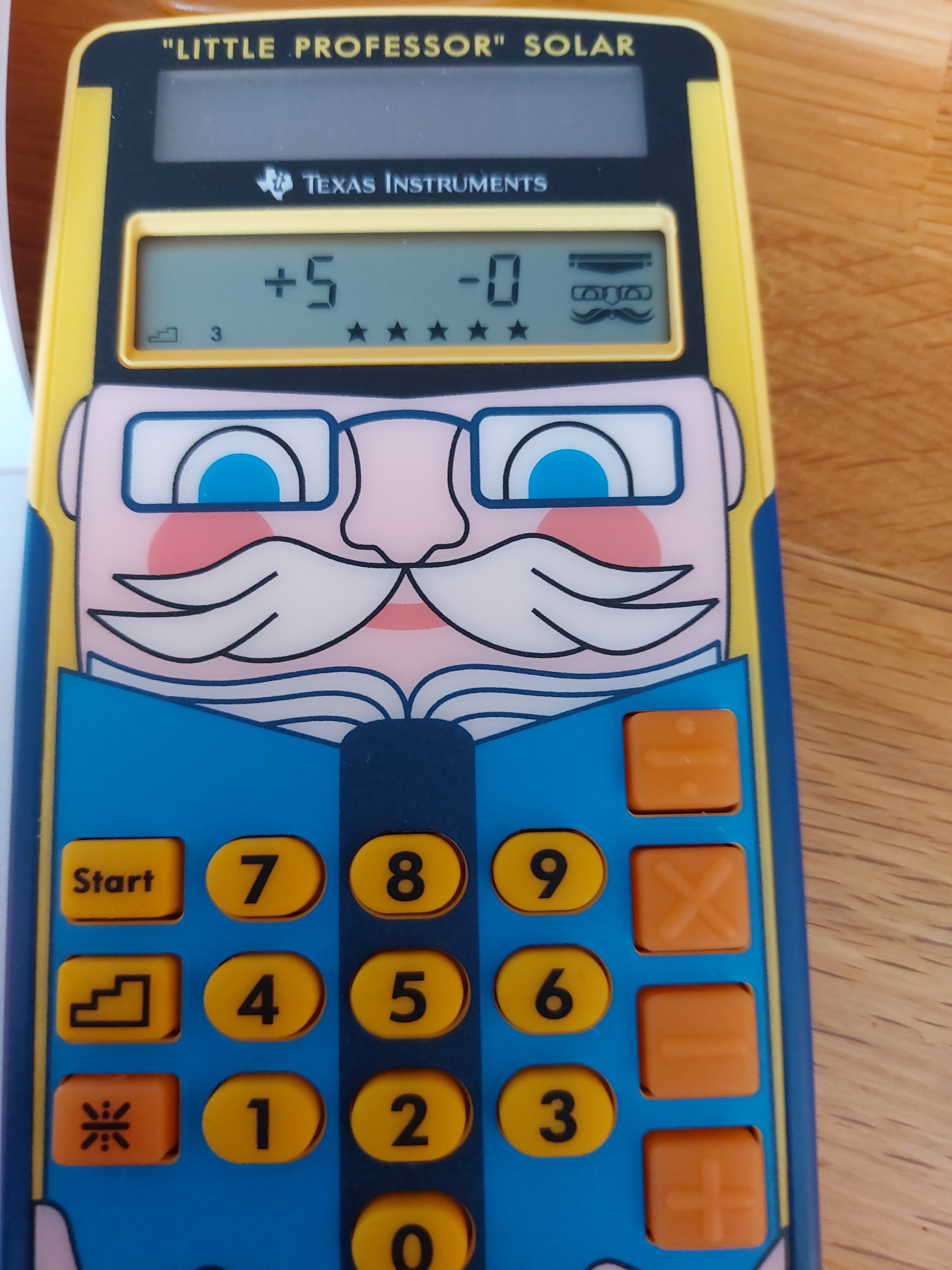
If you were a kid during the 1970s and 1980s, like I was, or a parent during that time, the calculator that I am about to review may bring back memories.


Quick Facts


Model:  "Little Professor" Solar (yes, the name is quoted on the calculator)

Company: Texas Instruments 

Years:  2011 - current

Type:  Education

Solar Powered 

Cost:  $ 17.50 US (Texas Instruments Educational Technology Store - 8/21/2022)


Working Our Arithmetic Muscles


The Little Professor Solar is an upgrade of the popular classic Little Professor from 1976.  Unlike the original, the solar version is 100% solar powered without a need for batteries.  


There are two modes:


*  Quiz

*  Arithmetic Tables


Quiz Mode


The Quiz Mode, activated by the [ Start ] key, selects an arithmetic problem to calculate based from one of five levels.  Level 5 is the most difficult, involving mostly two and three digit numbers.  


All the numbers are positive integers.  There is no decimal point, no negative numbers, no fractions.   All division problems divide equally without remainders.


Set the operator by pressing [ + ], [ - ], [ × ], or [ ÷ ].  The stairs button is selects the level, with the mode defaulting to level 1, which is for elementary students.  Levels 2 and higher are great for older students, those who are reviewing arithmetic, and those who want to practice their mental mathematic skills.  Change the level by pressing the key that has a stairs graphic on it (one the left side).  


On minor knock is that there is no contract between font and key on the arithmetic keys, which are bright orange.  I wish these keys would have contrast.  Thankfully, the arithmetic operators are raised so they can be felt.  


You will have two chances to solve the problem.  It is not timed, so take the time necessary.   After two incorrect answers, the Little Professor shows the correct answer.   After five problems, your score is shown.  The set is on five problems permanently.


The Quiz mode was present on the original Little Professor, but had 10 problems before displaying a score.  


Arithmetic Tables


The second mode is arithmetic drill table, which is activated by pressing the asterisk key  [ * ].  


Again, select an operator and then quickly enter a base within five seconds.  For example, if you want to practice numbers multiplied by 15, enter [ × ] 15.  


Five problems are given.


I don't believe the Arithmetic Tables mode is available on the original Little Professor.  


Final Thoughts


I think the Little Professor can be a compliment to arithmetic flash cards, possibly replace them if you don't want paper goods.  And one thing to remember is that the Little Professor Solar is not just for elementary school students, but can be used for anyone working on their arithmetic skills.  Worth a look and a buy.


There is also an app for the classic (not current) by grebulon for Android:


https://play.google.com/store/apps/details?id=com.grebulon.littleprofessor


Texas Instruments Online Store (United States, Canada, Europe):  https://epsstore.ti.com/OA_HTML/TIibeCCtdMinisites.jsp?ref_url=https%3a%2f%2feducation.ti.com%2fen%2fpurchase%2fpurchase


"Little Professor"  Wikipedia.   Last Edited on July 7, 2022 and accessed on August 21, 2022.  https://en.wikipedia.org/wiki/Little_Professor


Happy calculating,


Eddie 


All original content copyright, © 2011-2022.  Edward Shore.   Unauthorized use and/or unauthorized distribution for commercial purposes without express and written permission from the author is strictly prohibited.  This blog entry may be distributed for noncommercial purposes, provided that full credit is given to the author. 


The Sum and Product of Roots of a Quadratic Equation

The Sum and Product of Roots of a Quadratic Equation


Introduction


Let s, t be the roots of the equation a*x^2 + b*x + c = 0.


Let:


s = (-b + √(b^2 - 4*a*c)) / (2 * a)

t = (-b - √(b^2 - 4*a*c)) / (2 * a)


Then


s + t = -b / a

s * t = c / a


We see this topic a lot in algebra, let's see how these properties are derived. Fairly simple.  


Sum of the Roots


s + t

=  (-b + √(b^2 - 4*a*c)) / (2 * a) + (-b - √(b^2 - 4*a*c)) / (2 * a)

= (-2 * b) / (2 * a)

= -b / a


Product of the Roots


s * t 

=  (-b + √(b^2 - 4*a*c)) / (2 * a) * (-b - √(b^2 - 4*a*c)) / (2 * a)

= (b^2 + b * √(b^2 - 4*a*c) - b * √(b^2 - 4*a*c) - (b^2 - 4*a*c)) / (4*a^2)

= (b^2 - b^2 + 4*a*c) / (4*a^2)

= (4*a*c) / (4*a^2)


Eddie


All original content copyright, © 2011-2022.  Edward Shore.   Unauthorized use and/or unauthorized distribution for commercial purposes without express and written permission from the author is strictly prohibited.  This blog entry may be distributed for noncommercial purposes, provided that full credit is given to the author. 


Backlink 9999 Traffic Super

Order Now...!!!!